If you've ever wondered how the applications you use daily are created, how websites come to life, or how the complex systems that drive the modern world are built, you've come to the right place. This comprehensive article serves as your initial map on the fascinating journey of software development. Our goal is to demystify the fundamental concepts, introduce the essential tools, and inspire you to take the first steps in this dynamic and ever-evolving field.
What Exactly Does Software Development Mean?
At its core, software development is the process of creating a computer program or a set of programs to perform specific tasks. In other words, it is the art and science of transforming ideas into digital reality. Thus, it involves several stages, from the initial conception and planning to writing the code, rigorous testing, and the eventual deployment and maintenance of the software.
Firstly, it is crucial to understand that software is present in virtually every aspect of our lives. For example, from your computer's operating system and your smartphone's applications to the complex systems that control air traffic and banking transactions, software is the backbone of modern technology.
Furthermore, software development is not limited to just coding. In fact, it involves multidisciplinary collaboration, with professionals from various areas working together to ensure that the final product meets user needs and project objectives.
Why Learn Software Development?
Undoubtedly, the field of software development offers a vast range of opportunities and benefits. To begin with, the demand for qualified professionals is consistently high and continues to grow exponentially. Consequently, this high demand translates into excellent career prospects and competitive salaries.
Moreover, software development is an inherently creative and challenging field. In this sense, it allows you to solve complex problems, bring your ideas to life, and build tools that can impact the lives of millions of people. Therefore, if you have a curious mind, enjoy challenges, and have a passion for technology, this may be the ideal career for you.
Another important point is the constant evolution of the field. In this way, learning software development means embarking on a journey of continuous learning, keeping up-to-date with the latest technologies, tools, and methodologies. Therefore, this constant dynamic ensures that the work never becomes monotonous.
The Fundamental Pillars of Software Development
To begin your journey in software development, it is essential to understand some fundamental pillars that underpin the entire process. Next, we will explore these crucial concepts:
1. Programming Logic: The Foundation of Everything
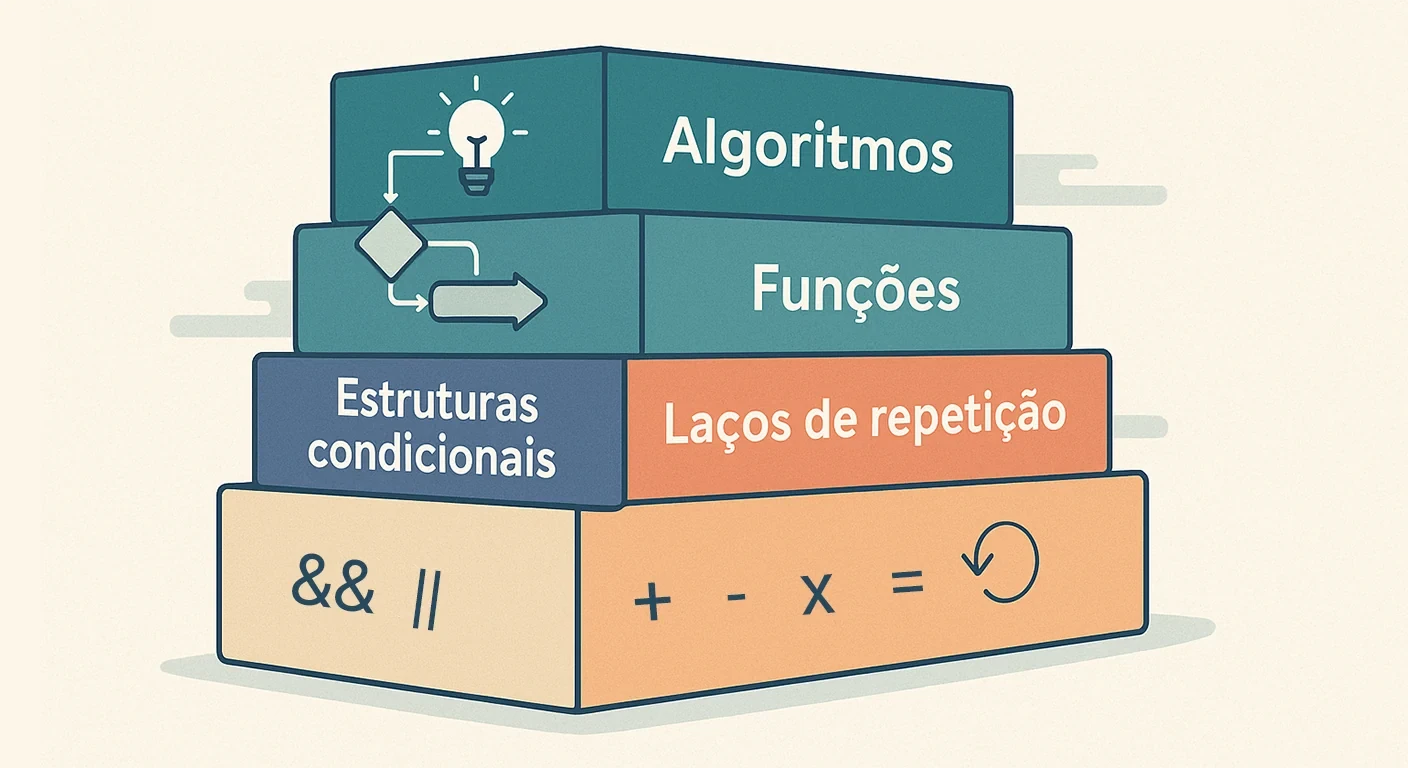
Firstly, programming logic is the backbone of software development. In simple terms, it is the ability to think in a structured and sequential way to solve problems through instructions that the computer can understand and execute. Thus, it involves the use of concepts such as variables, control structures (conditionals and loops), functions, and algorithms.
For example, imagine you want to create a program that tells you whether a number is even or odd. To do this, you would need to use programming logic to:
Consequently, mastering programming logic is the crucial first step for any aspiring developer. Fortunately, there are numerous online resources, tutorials, and courses that can help you develop this fundamental skill.
2. Algorithms: The Recipe for Software
Next, algorithms are finite sequences of well-defined steps that solve a specific problem. Analogously, think of an algorithm as a culinary recipe: each step must be followed in the correct order to obtain the desired result.
In this way, in the context of software development, algorithms are the basis for creating any program. For example, a search algorithm in a database defines the steps to find specific information, while a sorting algorithm organizes data in a particular order.
Therefore, understanding how to create and analyze efficient algorithms is an essential skill for a developer. Furthermore, choosing the right algorithm can have a significant impact on the performance and scalability of software.
3. Data Structures: Organizing Information
Another fundamental concept is data structures, which refer to how data is organized and stored in the computer's memory so that it can be accessed and manipulated efficiently. There are various data structures, each with its own characteristics and applications.
Some common examples include:
Therefore, choosing the appropriate data structure for a given problem can significantly optimize software performance. Consequently, a good developer must have a solid understanding of the different data structures and their respective advantages and disadvantages.
4. Programming Paradigms: Different Approaches to Coding
Furthermore, programming paradigms represent different styles or approaches to writing code. Each paradigm offers a distinct way of organizing and structuring software.
The most common paradigms include:
Therefore, understanding the different paradigms allows the developer to choose the most appropriate approach for the problem at hand, considering factors such as complexity, scalability, and code maintainability.
The Software Development Process: An Overview
Software development generally follows a well-defined life cycle, which involves several interconnected stages. Although there are variations, the fundamental process can be summarized as follows:
1. Requirements Gathering: Understanding the Problem
Initially, the first crucial step is to fully understand the problem that the software must solve and the needs of the users. This involves the collection and analysis of requirements, which describe in detail what the software should do, what functionalities it should have, and what the performance and usability criteria are.
To illustrate, if the goal is to develop an e-commerce application, requirements gathering will involve identifying functionalities such as a product catalog, shopping cart, checkout process, payment system, order management, and integration with logistics systems.
2. Design and Architecture: Planning the Solution
Next, with the requirements well-defined, the next step is the design and architecture of the software. At this stage, developers create a detailed plan of how the software will be structured, which components will be used, how they will communicate with each other, and which technologies will be employed.
For example, the architecture of a web application may involve defining the front-end (the user interface), the back-end (the server logic and database access), and the database itself. Furthermore, decisions about design patterns, scalability, and security are made at this stage.
3. Implementation: The Art of Writing Code
Subsequently, the implementation stage is where the software code is effectively written, based on the defined design and architecture. This is the most coding-intensive phase, and it involves choosing appropriate programming languages, frameworks, and libraries for the project.
During implementation, developers follow coding best practices, such as writing clean, well-documented, and modular code, facilitating maintenance and collaboration. Moreover, version control, using tools like Git, is essential for managing code changes over time.
4. Testing: Ensuring Software Quality
After implementation, the testing phase is crucial to ensure that the software works correctly, meets the requirements, and is free of errors (bugs). There are different types of tests, including unit tests (which verify small parts of the code), integration tests (which test the interaction between different components), system tests (which evaluate the software as a whole), and acceptance tests (which validate whether the software meets user needs).
Consequently, a rigorous testing process is fundamental to delivering high-quality software and avoiding problems in production. In this sense, test automation has become increasingly important to ensure the efficiency and coverage of tests.
5. Deployment: Putting the Software into Production
Once the software has been tested and approved, the next step is deployment, which involves placing the software in an environment where users can access and use it. The deployment process can vary depending on the type of software, and may involve installation on servers, publication in app stores, or integration with other systems.
Currently, many companies use DevOps (Development and Operations) practices to automate and streamline the deployment process, ensuring continuous and efficient software delivery.
6. Maintenance: Evolving and Supporting the Software
Finally, after deployment, the maintenance phase is essential to ensure that the software continues to function correctly, receives updates, bug fixes, and new features. Maintenance may involve system monitoring, log analysis, resolving problems reported by users, and implementing continuous improvements.
Therefore, the software development life cycle is an iterative and continuous process, where each stage influences the others, and user feedback is fundamental to the evolution of the software.
Essential Tools for Software Development
Modern software development benefits from a vast array of tools that assist developers in each stage of the process. Next, we present some of the most important categories of tools:
1. Integrated Development Environments (IDEs)
Firstly, IDEs are software applications that provide a complete environment for software development, integrating various essential tools in one place. They typically include a code editor, a compiler or interpreter, a debugger (to find and fix errors), and tools for project management and version control.
Some popular IDEs include:
Consequently, using an IDE can significantly increase developer productivity, making it easier to write, debug, and organize code.
2. Programming Languages: The Coding Tool
Next, programming languages are the fundamental tools for writing the instructions that the computer will execute. There are hundreds of programming languages, each with its own characteristics, syntax, and applications.
Some of the most popular and relevant programming languages for beginners include:
Therefore, the choice of programming language depends on your goals and the type of project you want to work on. It is recommended to start with a more accessible language like Python to learn the basic concepts.
3. Version Control Systems (VCS)
Another essential tool is a version control system, such as Git. A VCS allows you to track changes made to the code over time, facilitating collaboration between developers, managing different versions of the software, and reverting to previous versions in case of problems.
Platforms like GitHub, GitLab, and Bitbucket provide hosting services for Git repositories, as well as tools for collaboration, code review, and project management. Therefore, learning how to use a VCS is a fundamental skill for any developer working in a team or on medium to large-scale projects.
4. Testing Tools: Ensuring Quality
Furthermore, there are various testing tools that help developers ensure the quality of the software. These tools can automate the execution of tests, generate coverage reports, and identify potential errors and vulnerabilities.
Some examples include:
Consequently, the use of testing tools is crucial for delivering reliable and error-free software.
5. Project Management Tools
Finally, project management tools help development teams plan, organize, and track project progress. They typically offer features such as:
Some popular project management tools include:
Therefore, using a project management tool can improve collaboration, communication, and the efficiency of the development team.
The Path to Becoming a Software Developer
If you are motivated to start your journey in software development, here are some steps you can follow:
The Future of Software Development
The field of software development continues to evolve at a rapid pace, driven by technological advancements and changing user needs. Looking ahead, several trends are shaping the future of this exciting area:
In conclusion, the world of software development is vast, dynamic, and full of opportunities. By understanding the fundamental concepts, mastering essential tools, and embracing continuous learning, you can embark on a rewarding and impactful career in this exciting field. So, take the first step, explore the possibilities, and start building your digital future today!
Did you enjoy the article Unveiling the Universe of Software Development? Check out more here.