The Depth of Programming Logic in the Current Technological Landscape
In the intricate universe of software development, programming logic emerges not merely as a set of rules, but as the very intellectual architecture that underpins the creation of sophisticated computational systems. For experts in the field, understanding programming logic in its entirety transcends mere knowledge of specific language syntaxes and commands. It involves internalizing a way of thinking, a structured methodology to break down complex problems, devise efficient algorithmic solutions, and consequently, build robust, scalable, and high-performance applications.
The constant evolution of technology imposes upon professionals in the area a continuous improvement of their logical skills. The complexity of current systems, driven by fields such as artificial intelligence, machine learning, big data analysis, and distributed computing, demands refined programming logic and a high capacity for abstraction. In this context, programming logic is not static knowledge, but rather a dynamic discipline that adapts and refines itself in response to new challenges and computational paradigms.
Unveiling the Fundamental Concepts
At the heart of programming logic lies the idea of an algorithm. An algorithm can be defined as a finite and well-defined sequence of steps or instructions that, when executed, solve a specific problem. Think of a cooking recipe: it describes step-by-step how to prepare a dish. Similarly, an algorithm describes how a computer should proceed to achieve a desired result.
To build effective algorithms, some concepts are crucial:
Demystifying Fundamental Principles from an Advanced Perspective
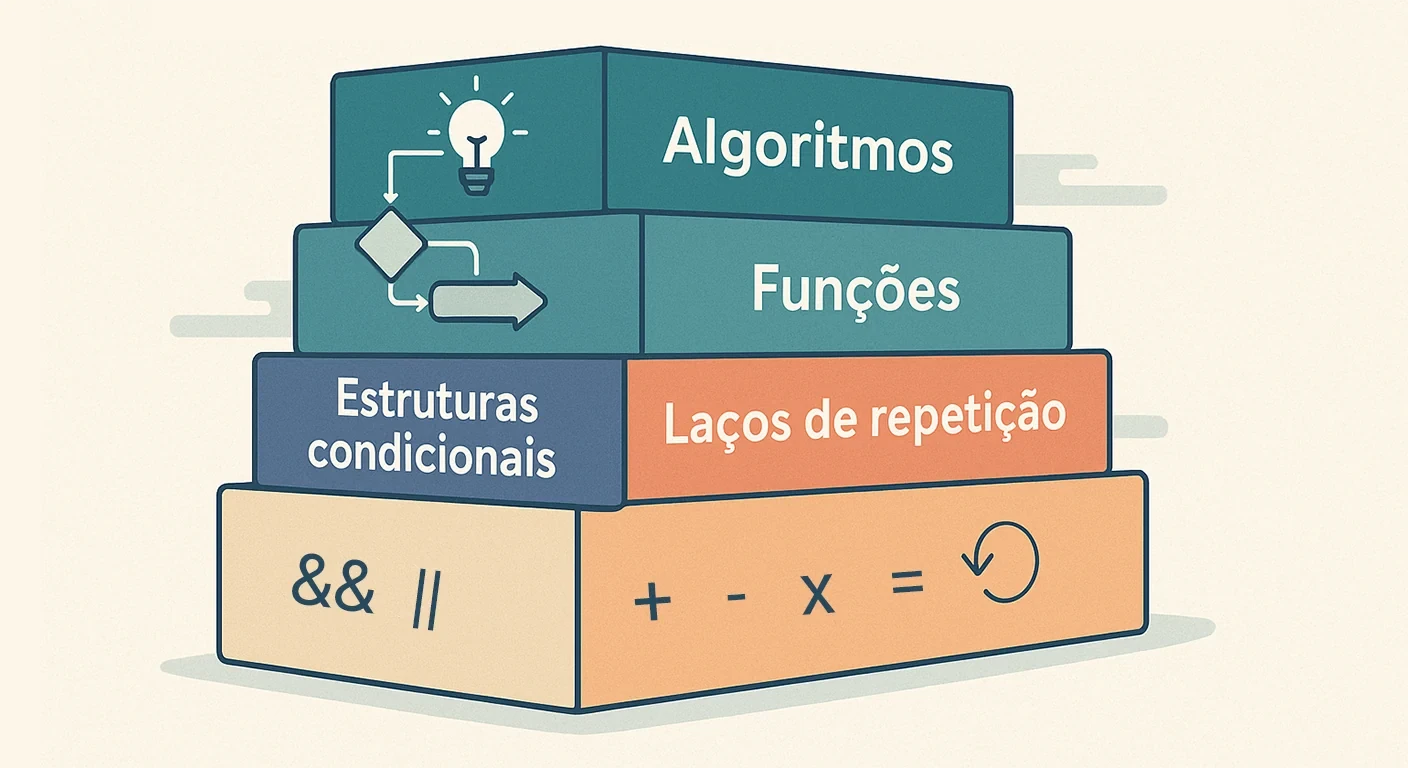
Although the fundamental principles of programming logic – sequentiality, selection, and repetition – are often introduced in the early stages of learning, their application and implications in a professional context are vastly more profound.
Sequentiality:
In complex systems, ensuring the sequential execution of critical operations is fundamental to data integrity and system state consistency. The orchestration of multiple concurrent tasks, for example, requires careful sequential planning to avoid race conditions and other undesirable behaviors. Thus, understanding sequentiality at an advanced level involves managing dependencies between tasks and synchronizing processes in multithreaded or distributed environments.
Selection (Conditional):
Decision-making in advanced systems often involves evaluating multiple interconnected conditions. In this sense, complex conditional structures can be nested or combined using sophisticated logical operators to implement complex business policies and adaptive control flows. Furthermore, optimizing conditional chains to improve code performance and readability becomes a crucial concern for specialists.
Repetition (Iteration):
In applications that handle large volumes of data or require continuous processing, the efficiency of repetition structures is paramount. Therefore, choosing between different types of loops (for, while, do-while) and implementing optimization techniques, such as reducing computational complexity and using appropriate data structures, are essential aspects of advanced programming logic. Moreover, in parallel computing scenarios, efficiently distributing iterations among multiple processors or compute nodes requires a deep understanding of parallel programming logic.
Modularization and Abstraction as Pillars of Scalability
The ability to modularize code and abstract complexity are distinguishing features of well-designed and scalable systems. Programming logic plays a central role in defining cohesive modules and creating clear interfaces that hide implementation details.
Programming Paradigms and the Expression of Logic
Different programming paradigms offer distinct approaches to organizing and expressing programming logic. Understanding the nuances of each paradigm is fundamental to choosing the most appropriate approach for a given problem.
Algorithm Optimization: Elevating Logic Efficiency
Creating efficient algorithms is one of the primary goals of advanced programming logic. Algorithm optimization involves reducing computational complexity in terms of execution time and memory resource usage.
Developing Logical Thinking for Experts
For experts, developing logical thinking is a continuous process that goes beyond simply solving programming problems. It involves the ability to critically analyze complex requirements, identify ambiguities, model abstract systems, and communicate solutions clearly and concisely.
Programming Logic in the Context of Artificial Intelligence and Machine Learning
Programming logic plays a fundamental role in the development of artificial intelligence and machine learning systems. Although these fields involve advanced statistical and mathematical concepts, implementing AI and ML algorithms requires solid programming logic to ensure the efficiency, scalability, and interpretability of the models.
Implementation of Learning Algorithms:
Translating machine learning algorithms, such as linear regression, decision trees, and neural networks, into executable code requires precise and efficient programming logic.
Data Processing and Manipulation:
Preparing and processing large volumes of data for training AI and ML models requires applying programming logic techniques for data cleaning, transformation, and organization.
Development of Inference Systems:
Building systems that use AI models to make decisions or predictions requires implementing programming logic to integrate the models with other system components and to define inference flows.
The Intrinsic Importance of Programming Logic
Programming logic transcends the mere syntax of a specific language. It is the foundation for:
Challenges and Future Trends in Programming Logic
Programming logic continues to evolve in response to new challenges and technological trends. The increasing complexity of distributed systems, the proliferation of connected devices, and the demand for more intelligent and adaptive applications impose new demands on professionals in the field.
Conclusion: The Enduring Essence of Logic in the Digital Age
In summary, programming logic transcends mere coding; it represents the very essence of computational thinking and the backbone of innovative and efficient software creation. For experts, deepening their understanding of programming logic in its most advanced aspects is fundamental to tackling the complex challenges of the current and future technological landscape.
Mastering principles, optimizing algorithms, exploring different paradigms, and cultivating sharp logical thinking are indispensable investments for any professional aspiring to lead and innovate in the field of software development.
Programming logic, therefore, is not just a technical skill, but a way of thinking that shapes how we interact with technology and build the digital world around us.
Did you like the article Programming Logic: Unveiling the Intellectual Architecture of Modern Software? Check out more here.